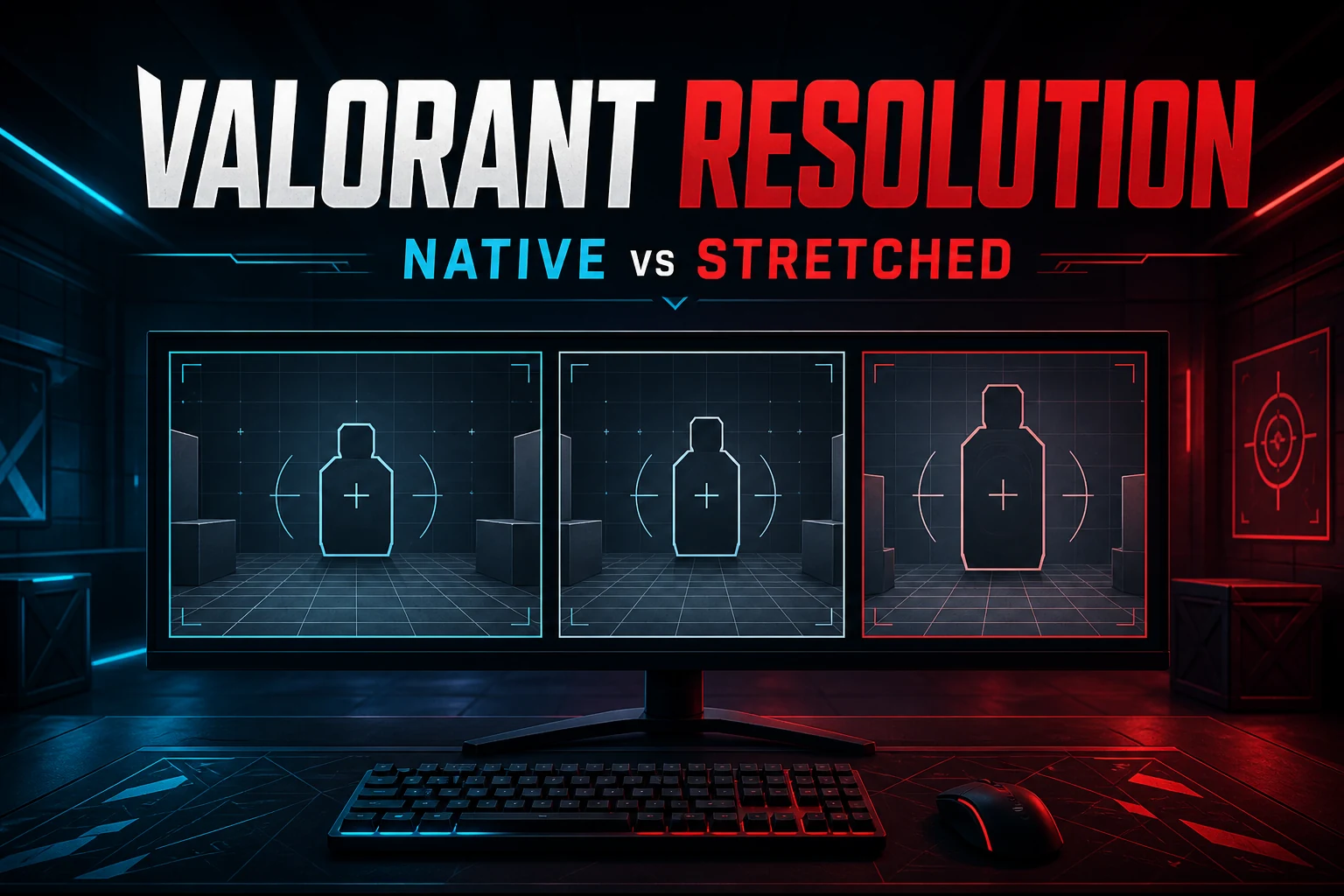
Quick answer: use your monitor’s native resolution and a supported refresh rate for a clear Valorant setup. On a 1080p monitor, that means 1920×1080. For 4:3, start with 1440×1080 if you want a sharper image or 1280×960 for the familiar lower-resolution look. Riot lists both as supported resolutions. Set Aspect Ratio Method to Fill. If you get black bars, change GPU scaling to full-screen or full panel instead of changing your sensitivity.
Valorant’s FOV is locked at 103. The normal in-game 4:3 setting changes the HUD, crosshair, and weapon view. Full-panel GPU scaling can make the displayed image look wider, but it does not change hitboxes or give you extra side vision. Riot also removed a windowed 4:3 exploit that produced stretched FOV in patch 9.09. Test the supported setup in Deathmatch, and leave your mouse sensitivity alone unless the visual change genuinely throws off your aim.
1280×960 is a supported 4:3 option if you prefer a wider-looking crosshair. Rendering at a lower resolution may improve FPS, but stretching the image itself does not guarantee a performance or aiming advantage.
Quick take
Jump to a section- Quick picks
- Best stretched res
- Supported 4:3
- Does it help?
- Setup guide
- Normal vs true
- FPS impact
- FAQ
Best Valorant resolution: quick picks
Use your monitor’s native resolution for a clear default. On a 1080p monitor, choose 1920×1080.
Use 1280×960 if you want the classic 4:3 stretched look. The tradeoff is a softer image, so it is better for players who already know they like that wider-looking crosshair and UI.
Use 1680×1050 if you want a lighter stretched feel without making Valorant look as blurry as 4:3. It is the better first test if you are curious but do not want the game to look too distorted.
FOV, or field of view, is how much of the game world your camera can see at once. Valorant keeps its horizontal FOV locked at 103, so resolution changes are about feel, clarity, and FPS, not about seeing more of the map.
Best stretched resolution for Valorant in 2026
There is no single best stretched resolution for Valorant. The right choice depends on whether you want a slight stretch, a heavy 4:3 look, or just better FPS from a lower resolution. Start with one of these:
Swipe left to compare every resolution →
| Resolution | Aspect ratio | Best for |
|---|---|---|
| 1920×1080 | 16:9 | Native choice for 1080p monitors; a standard 16:9 option |
| 1680×1050 | 16:10 | Light stretch without making the game look too distorted |
| 1440×1080 | 4:3 | Sharper 4:3 option with full 1080-pixel vertical detail |
| 1280×960 | 4:3 | Classic lower-resolution 4:3 feel for players coming from CS-style settings |
| 1024×768 | 4:3 | Low-end PCs that need extra FPS and do not mind a softer image |
| 1600×900 | 16:9 | Lower-FPS-cost option if you want better performance without stretching |
1440×1080 (4:3): This is the sharpest common 4:3 choice on a 1080p monitor because it keeps all 1080 vertical pixels. Riot includes 1440×1080 in its supported-resolution list.
1280×960 (4:3): This is the classic lower-resolution 4:3 pick. It gives Valorant a wider-looking HUD and crosshair, but the picture is noticeably less sharp than 1440×1080 or native 1080p.

1680×1050 (16:10): This is a good middle ground if 4:3 feels too distorted. It keeps more image clarity while still giving the UI and crosshair a slightly wider look.

1024×768 (4:3): This is mainly for players who need performance more than image quality. It can help weaker PCs, but the game will look blurrier on modern monitors.
Riot-supported 4:3 resolutions
Riot’s current support list includes 1024×768, 1280×960, 1400×1050, and 1440×1080 among its 4:3 modes. Start with 1440×1080 for clarity or 1280×960 if you need to render fewer pixels. Unsupported custom modes may fail, show black bars, or disappear after a driver update, so there is little reason to begin with a config-file workaround.
Riot’s supported resolutions guide is the reference for modes the game accepts. Riot’s patch 9.09 notes also confirm that the old windowed 4:3 stretched-FOV exploit was removed.
Does stretched resolution help in Valorant?
Stretched resolution can help if you personally aim better with a wider-looking crosshair or if your PC benefits from rendering fewer pixels. It does not magically increase your true FOV, and it does not require a new Valorant sensitivity.
The main tradeoff is clarity. Your monitor’s native resolution usually makes enemies, utility, and map details easier to read. Stretched resolutions can feel snappier or more familiar if you came from Counter-Strike, but they are a preference setting, not a must-use competitive advantage.
How to get stretched resolution in Valorant
- Open Valorant and go to Settings.
- Choose the Video tab, then the General tab.
- Open the Resolution dropdown and select the resolution you want to test.
- Set Aspect Ratio Method to Fill if you want the stretched look.
- Apply the change, then test your crosshair, tracking, and spray control in the Range or Deathmatch.
If the option you want is missing, create it in your GPU control panel first, then relaunch Valorant. Do not accept a custom mode if the screen fails its test. Check the refresh-rate dropdown again after every resolution change, since Windows or the driver can fall back to a lower rate.
NVIDIA stretched resolution setup
- Open NVIDIA Control Panel > Display > Change resolution.
- Pick the correct monitor, choose Customize, then Create Custom Resolution.
- Enter 1280×960 or another resolution your monitor supports. Keep the refresh rate at a value the display is rated to handle.
- Use Test. Save the mode only if the image returns normally.
- Open Adjust desktop size and position, choose Full-screen scaling, then select the new resolution in Valorant and set Aspect Ratio Method to Fill.
NVIDIA’s own help pages document the custom-resolution test and save flow and explain that Full-screen scaling stretches a lower-resolution image to fill the display.
AMD stretched resolution setup
- Open AMD Software, then go to the display settings for the monitor you use for Valorant.
- Enable GPU Scaling.
- Set Scaling Mode to Full panel. AMD says Preserve aspect ratio can leave bars, while Full panel expands a non-native resolution to the whole screen.
- Select the resolution in Valorant and use Fill.
AMD’s GPU scaling guide also recommends running the display at its native resolution and refresh rate before configuring scaling.
Normal stretched res vs true stretched in Valorant
The normal, repeatable method is the one above: choose a lower 4:3 or 16:10 resolution, use Fill in Valorant, and let the GPU scale it across the monitor. This reliably stretches interface elements, the crosshair, and the weapon view. Valorant still uses its locked camera FOV, so the setup does not reveal more of the map.
“True stretched” tutorials usually promise a wider-looking 3D scene through extra config edits, display tricks, or third-party tools. Those methods are less consistent across patches and drivers. They can also reset, break capture software, or leave the desktop at the wrong resolution. This guide sticks to the in-game and GPU-driver controls because they are easy to reverse and do not require third-party software.
How to fix black bars or a blurry image
- Black bars: use Full-screen in NVIDIA Control Panel or Full panel in AMD Software, then keep Fill selected in Valorant.
- Wrong monitor: apply scaling to the display where Valorant opens, not a second screen.
- Blurry picture: move up from 1024×768 to 1280×960, try 1680×1050, or return to your monitor’s native resolution.
- Refresh rate dropped: reselect the monitor’s intended Hz value after changing resolution.
- Bad custom mode: wait for the driver’s test countdown to revert it. Do not keep a mode that flickers or loses signal.
Does stretched resolution affect FPS?
Lower resolutions can improve FPS because your PC is rendering fewer pixels. That benefit comes from the lower resolution, not from the stretch itself. If you only care about performance, you can also use a lower 16:9 resolution like 1600×900 or 1280×720 without stretching the image.
Pro tip
A lower resolution can make the image softer and may improve FPS, depending on your PC. Compare your frame rate at each setting rather than assuming that stretching alone makes the game faster.
For more performance tuning, use our best Valorant graphics settings guide. If your stretched resolution makes your crosshair feel different, compare it with our Valorant crosshair guide before changing everything at once.
Valorant FOV and stretched resolution FAQ
Can you change FOV in Valorant?
No. Valorant does not have a normal FOV slider. The game is played at a locked 103 FOV, and changing resolution only changes how the image is displayed.
What is the best Valorant FOV?
The best Valorant FOV is the default locked FOV of 103 because that is what the game uses. You cannot raise it like Apex, Overwatch, or other FPS games.
Does stretched resolution make enemies bigger in Valorant?
Full-panel scaling can make the displayed picture and models look wider, but it does not enlarge hitboxes or unlock extra FOV. Treat the effect as a visual preference, not a guaranteed aim boost.
Should I use 1280×960 in Valorant?
Try 1280×960 if you like a heavy 4:3 stretched look or you are used to CS-style settings. If the game looks too blurry, switch back to 1920×1080 or try 1680×1050 as a lighter stretch.
Does stretched resolution change Valorant sensitivity?
No. Your Valorant sensitivity value does not need to change when you swap resolution. Test tracking and flicks after the switch, but do not change sensitivity unless your aim actually feels off.
What is true stretched resolution in Valorant?
Players use “true stretched” for methods that try to stretch more than Valorant’s normal HUD, crosshair, and weapon view. Those workarounds can depend on driver, config, or third-party behavior. For a stable setup, use an in-game resolution with Fill plus full-screen GPU scaling.
Updated September 17, 2026: added Riot’s supported 4:3 list, a sharper 1440×1080 recommendation, and the official patch 9.09 note explaining why the old windowed stretched-FOV exploit no longer applies.
 MONITOR
 KEYBOARD
 HEADSET
 MONITOR